Open'er Festival
Open'er Festival
Open'er Festival
(About the exhibition)
Pop-up at the Open'er Festival
Pop-up at the Open'er Festival
Pop-up at the Open'er Festival
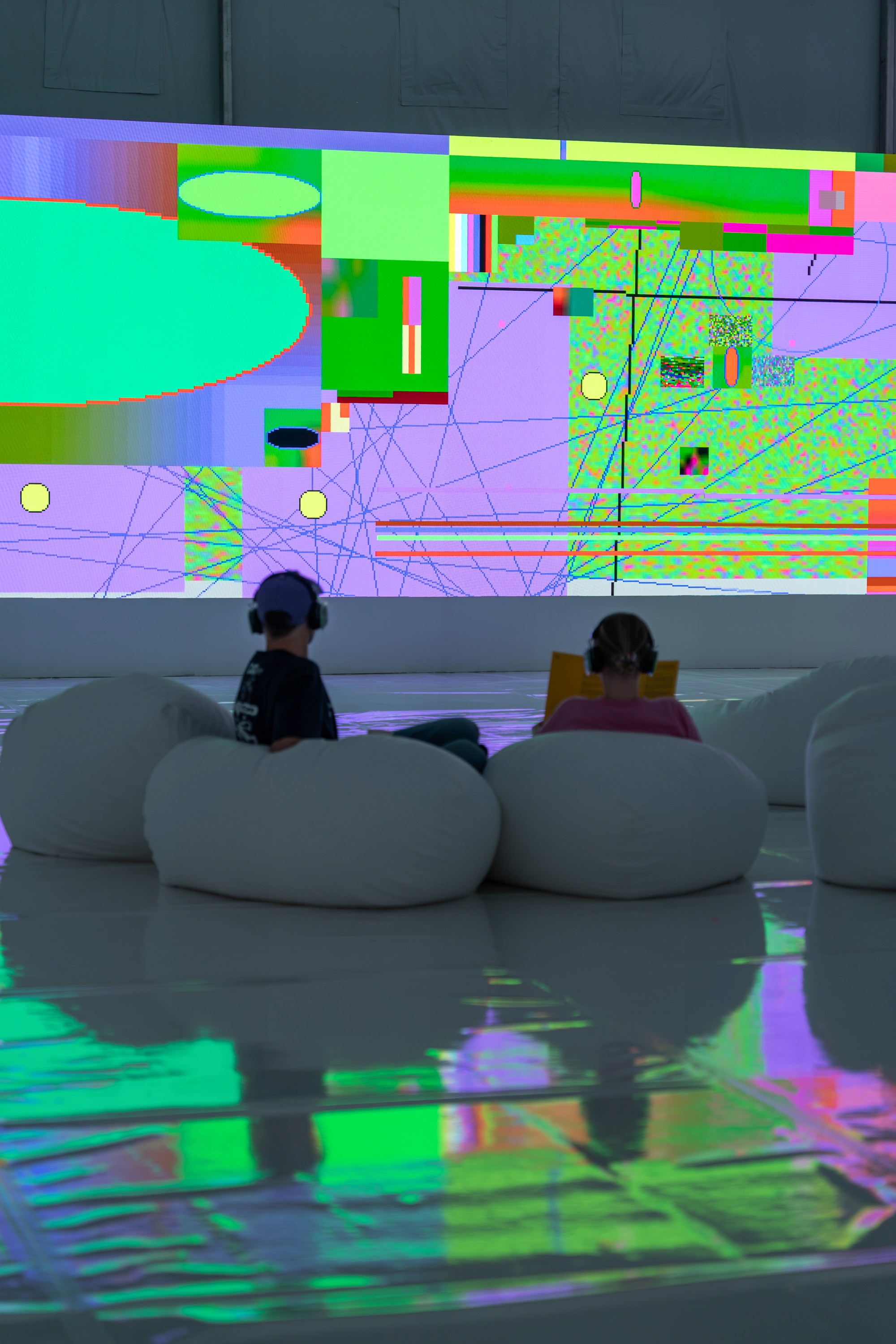
Harmonoise – an immersive installation that translates formal principles of painting into the world of modern kinetic art. In a specially adapted festival space, the monumental, looped animation functions in a dialogue with Daniel Szlajnda's original soundtrack. Przemek Blejzyk, known as Sainer, is a contemporary painter whose work, rooted in traditional painting and translated into new media, seeks a new language for the visual arts. A unique guided tour of the exhibition on 2.07 starts at 17:00
Przemek Blejzyk, known as Sainer, is a contemporary painter whose work has a strong, undeniable connection to the tradition and history of painting. He built his position as one of the most recognized muralists of recent decades, yet his current interests and artistic practice have almost completely broken away from this stage of his creative journey. Instead, drawing on the heritage of prominent Impressionists and Fauvists, and influenced by contemporary aesthetics, he constructs distinctive works combining their profound perceptual sensitivity with the sensory overload and hyper-vibration of the 21st century. (Sasha Bogojev)
“I am more interested in describing the era through contemporary mechanisms of seeing. When I draw landscapes in sketchbooks, I sometimes combine several of them on one page, creating a single composition of different views linked by a color relationship. Our computer, TV, or smartphone screens are divided into multiple windows that we see simultaneously. Instead of reproducing the icons that surround us, I want to explore contemporary painting through the way we consume images." (Sainer)
During Open’er, we are organizing three guided tours, including two on the festival grounds:
🟢 on Thursday 2.07 at 17:00, curator Agata Abramowicz will talk about Harmonoise
🟢 on Friday 3.07 at 17:00, Sainer will give a tour of his work in English
🟢 and on Saturday, we invite you to a bilingual (Polish-English) guided tour of the locations in Gdynia Śródmieście with Agata Abramowicz and Monika Chaka Domańska.
Photo by Ola Mac
Gdynia was not created by accident. The choice of a small Kashubian village for the construction of the port was decided by its location: access to the sea, a sheltered bay, and the shape of the coastline, which created exceptionally good conditions for the development of modern infrastructure. It was the natural features of this place that became the foundation of one of the most important modernization stories of the Second Polish Republic.
However, the modern city was built in an area that already had its own history and its own inhabitants - people, animals, and heroes of Kashubian beliefs. Stolems, Borowa Cotka, Leshy, Mórki, or Topielce can be treated as personifications of the forces of nature: the sea, forest, wetlands, and hills that existed before the city and continue to co-create its unique character.
The boundary between nature and the city is less obvious than we tend to think. Animals appearing on the streets of Gdynia do not enter a foreign world; rather, they show that we still share the same space. The sea, forests, and peat bogs are not only a beautiful landscape but also a condition of life and a source of resources that we used both a hundred years ago and today.
Thinking about the future of the city, we cannot forget this bond. In Kashubian stories, alongside the guardians of nature, there also appears Smętek - the spirit of the place, a figure of anxiety and loss, reminding us that development and progress come at a price. The future depends not only on how far we can go, but also on how well we understand our own boundaries and dependencies.
Agata Abramowicz
Gdynia is a city born from the imagination. It was created as a project of the future – modern, open, and facing the world. Its architecture, public space, and port were meant to respond to the needs of its residents and the young Polish state, but also to shape a new way of life: healthier, more conscious, and based on a belief in progress, education, and community.
For decades, this narrative built the city's identity. Today, however, we return to it with greater distance. The grand narratives and simple promises of a better tomorrow no longer sound as convincing as they did a century ago. Instead of a single history, questions arise about those who remained out of frame, the costs of development, and the ideas that were meant to lead toward emancipation,
but sometimes became tools of control and exclusion.
The presented works look at the legacy of modernism not as a closed chapter of history, but as a living matter. Here, architecture becomes a carrier of memory, and past visions of the future – a reference point for contemporary social imaginaries and doubts. Alongside a fascination with form, technology, and design, there is a reflection on the fragility of social order and on how easily the idea of progress can give way to conflict, violence, and chaos.
A hundred years ago, Gdynia's future seemed like a project that could be planned. Today we know that no vision is free from errors, dead ends, and unforeseen consequences. The exhibition thus looks not only at what we have inherited from modernity, but also at the questions that return with every era of acceleration, uncertainty, and change. Perhaps that is precisely why the past remains one of the most interesting tools for thinking about the future.
(Address)
As part of the Open'er Festival
(Artists)
SAINER

